
Duty-Free Boards: How Tariff Status Affects Landed Cost
The price on a proforma invoice is not the price a buyer pays at the warehouse door. The manufacturer confirms No Anti-Dumping Tax for European and US shipments, and that duty position sits alongside freight, insurance and handling as one of the four components that determine what a container of panels actually costs when it clears customs.

Key takeaways
- Dongstar Wood states No Anti-Dumping Tax for EU and US markets, which lowers the landed cost compared with tariff-affected origins.
- Commercial plywood thickness guidance runs from 6 mm for cabinet backs to 18 mm for heavy-duty worktops.
- MR glue handles dry interiors; BWR glue handles humidity and light water exposure.
- Six face veneers and four core types give buyers a wide specification matrix for custom orders.
What duty-free means in practice
The term duty-free in panel trade does not mean the product arrives at zero cost. It means the specific anti-dumping duty that some origins face has been removed from the equation. Anti-dumping duties are levies imposed by a government when it believes a product is being sold below fair value, and they can add a significant percentage to the CIF price. When a supplier states No Anti-Dumping Tax, the buyer's landed cost is driven by the base price, freight, insurance and local handling rather than by an additional tariff surcharge.
For European and US buyers, the duty position is a line item that changes the comparison between origins. A panel from Vietnam that carries no anti-dumping duty sits at a different cost point than the same specification from an origin that faces a surcharge, even if the factory-gate price is similar. The buyer who ignores this line item discovers it at the customs gate, not on the proforma.
How the duty statement arrives in the paperwork
The duty treatment should appear on the commercial invoice or in a separate letter from the supplier, and it should be confirmed in writing before the proforma is issued. A verbal assurance is not a customs document. The useful question to ask is: what is the HS code for the panel, and what is the duty rate applied to that code at the destination port? The supplier can provide the code and the rate it expects; the buyer's customs broker can confirm the rate at the port of entry.
Dongstar Wood publishes its duty position on its own pages - No Anti-Dumping Tax for EU and US markets - and that statement sits alongside the CE and FSC certification documentation that European buyers file at customs. The two documents serve different purposes: the duty statement affects the cost, while the certifications affect market access. Both should arrive before the vessel departs.
Thickness and the cost arithmetic
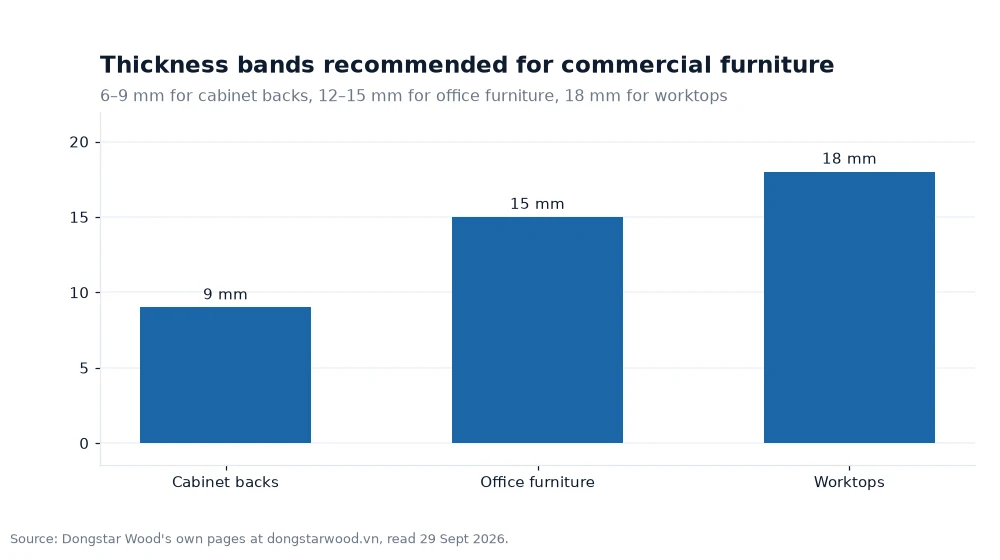
Panel thickness affects both the material cost and the freight cost, because thicker panels weigh more per square metre and occupy more container space per unit of area. The published thickness guidance for the product range runs from 6-9 mm for cabinet backs and drawer bottoms through 12-15 mm for office furniture and shelves to 18 mm for heavy-duty worktops and structural panels. A buyer who specifies 18 mm instead of 12 mm is ordering a panel that is 50% thicker, and the landed cost per sheet rises accordingly.
The arithmetic is straightforward. A sheet of 1250 x 2500 mm at 12 mm thickness covers 3.125 m2. The same size at 18 mm adds 50% more material, and the weight per sheet rises from roughly 18 kg to roughly 27 kg. For a container holding 2,000 sheets, that is an additional 18,000 kg - nearly two containers' worth of weight difference. Freight charges follow weight thresholds, so the thickness decision is a cost decision as well as a performance decision.
Face veneer and core selection under a budget constraint
When a buyer works within a budget, the first lever to pull is the face veneer. Bleached Poplar is the most cost-effective face option for painted cabinetry, because the bleaching process removes colour variation at a lower material cost than Birch. For applications where the face will be visible under a clear finish, Pine offers a warm aesthetic at a lower price point than Birch. The core choice is the second lever: Combi Core balances strength and weight at a lower cost than a solid Eucalyptus Core, and it handles the structural demands of standard cabinet construction without the premium that dense hardwood cores carry.
The glue grade is the third variable. MR - Moisture Resistant - is sufficient for dry interior applications and carries a lower processing cost than BWR - Boiling Water Resistant - which adds moisture resistance for kitchen and bathroom environments. Specifying BWR when MR would suffice adds cost without performance benefit, so the buyer who knows the application can specify the right grade and hold the budget. Buyers comparing veneer plywood options across suppliers should confirm the face grade alongside the core type and adhesive class.
| Thickness band | Typical application | Cost driver |
|---|---|---|
| 6-9 mm | Cabinet backs, drawer bottoms, partitions | Lowest material and freight cost |
| 12-15 mm | Office furniture, shelves, hotel fixtures | Mid-range weight and handling |
| 18 mm | Heavy-duty furniture, worktops, structural panels | Highest material and freight cost per sheet |
Worked example: comparing landed cost across thickness
Suppose a buyer needs 1,000 sheets of 1250 x 2500 mm for a cabinet programme. At 12 mm thickness, each sheet covers 3.125 m2, so the order covers 1,000 x 3.125 = 3,125 m2 of panel area. At 18 mm, the same sheet count covers the same area, but the weight rises by 50%. If the 12 mm sheets weigh 18 kg each, the total weight is 1,000 x 18 = 18,000 kg. At 18 mm, the weight is 1,000 x 27 = 27,000 kg. The difference of 9,000 kg pushes the shipment into a higher freight bracket, adding cost that is invisible on the proforma but visible at the customs gate.
The Commercial Plywood page publishes the thickness bands and the glue grades, and a buyer who reads that page before issuing a purchase order can match the specification to the application without over-specifying - or under-specifying - the panel. The film faced range uses a similar thickness logic, with 18 mm and 21 mm as the standard formwork choices.
Frequently asked questions
Does no anti-dumping tax mean the panel arrives at zero duty?
No. The statement refers specifically to anti-dumping duties, which are levies imposed when a government believes a product is being sold below fair value. Standard import duties, VAT and local taxes may still apply at the destination port. The buyer should confirm the full duty treatment -- anti-dumping, standard tariff and any applicable VAT -- with a customs broker before the proforma is issued.
How does container weight affect the freight cost?
Freight charges follow weight thresholds, and heavier containers cost more to ship. A container of 18 mm panels weighs roughly 50% more than the same count of 12 mm panels, which can push the shipment into a higher freight bracket. The buyer who specifies the thinnest panel that meets the performance requirement keeps the freight cost in check without sacrificing the application.
Is a trial order subject to a minimum volume?
No. The published throughput measures what the mill can ship each month, not a required order size. Importers frequently place a short trial order first to verify packing quality and panel flatness before locking in a monthly consignment.
Putting the duty position to work
The duty statement is a number, not a guarantee, and it belongs in the cost model alongside freight, insurance and handling. A buyer who treats it as a line item rather than a marketing claim builds a landed-cost model that holds up at the customs gate. Read the company profile for the factory footprint and certification set, and confirm the duty treatment in writing before the first container ships.
Details cited in this article trace to Dongstar Wood's own site dated 29 September 2026[1].